Gōdō Martial Arts
WKO Pointfighting Rules & PPE Standard
Sport: Tatami Pointfighting
Governing reference: World Kickboxing Organisation (WKO)
Club: Gōdō Martial Arts
1. Purpose
Gōdō Martial Arts uses the World Kickboxing Organisation (WKO) Pointfighting rules as the benchmark for its points-sparring training and competition preparation.
The purpose of these rules is to provide a clear, controlled and consistent framework for Pointfighting while maintaining the highest reasonable standard of safety for students.
Where Gōdō training requirements are more protective than the WKO competition minimum, the Gōdō requirement applies during club training.
2. Mandatory WKO Pointfighting PPE
The following equipment forms the WKO Pointfighting equipment standard.
Head Guard
Juniors: Mandatory.
Adults: Optional under WKO competition rules but recommended by Gōdō Martial Arts for training.
The head guard must be purpose-designed martial-arts protective equipment and securely fitted.
Gum Shield
Mandatory.
A properly fitted martial-arts or boxing gum shield must be worn during sparring.
Pointfighting Gloves
Mandatory.
WKO specifies open-hand gloves with the fingers and thumb covered.
Boxing gloves are not the appropriate glove for WKO Pointfighting.
Foot Protection
Mandatory.
Safety foot pads must be worn.
Shin Guards
Mandatory.
Shin guards must be worn under the clothing.
Groin Protection
Mandatory.
Groin protection must be worn under the clothing.
Female Competitors
A breast protector is recommended by WKO.
Gōdō Martial Arts may require additional protection where the instructor considers it appropriate for the student’s age, experience or level of contact.
Optional Protection
WKO permits:
Elbow pads
Knee pads
Hand wraps
If hand wraps are used, fist taping is not permitted under the WKO Pointfighting equipment specification.
3. Gōdō Club PPE Requirement
For Gōdō Martial Arts training, the following minimum equipment is recommended:
| PPE | Juniors | Adults | Gōdō requirement |
|---|---|---|---|
| Head guard | Mandatory | Optional under WKO; recommended | Mandatory for all Gōdō sparring |
| Gum shield | Mandatory | Mandatory | Mandatory |
| Pointfighting gloves | Mandatory | Mandatory | Mandatory |
| Foot protection | Mandatory | Mandatory | Mandatory |
| Shin guards | Mandatory | Mandatory | Mandatory |
| Groin protection | Mandatory | Mandatory | Mandatory |
| Breast protection | Recommended | Recommended | Recommended |
| Elbow pads | Optional | Optional | Recommended |
| Knee pads | Optional | Optional | Optional |
| Hand wraps | Optional | Optional | Optional |
| Fist taping | Not permitted | Not permitted | Not permitted |
Gōdō may require additional PPE at any time where the instructor considers it necessary for safety.
4. Fighting Area
WKO Pointfighting takes place on a square matted area.
Dimensions
Minimum: 6 m × 6 m
Maximum: 8 m × 8 m
Minimum mat depth: 20 mm
A 2 m safety zone must be maintained around the fighting area.
Spectators must remain outside the safety zone.
The officials’ table should have appropriate scoring equipment, stopwatch and bell.
Appropriate medical provision must also be available at events.
5. Legal Target Areas
Pointfighting scoring techniques are directed towards the permitted areas of the opponent’s:
Head
Body
Low kicks, groin attacks, attacks to the back and attacks to the top of the head are prohibited.
6. Legal Hand Techniques
The WKO Pointfighting rules permit:
Back fist / back knuckle strike
Reverse punch
Ridge hand
Blitz-style combinations
Straight punches
The WKO’s official legal/foul technique document confirms the permitted Pointfighting hand techniques and identifies elbow strikes, spinning backfists, palm strikes and forearm strikes as fouls.
Important
A spinning backfist is NOT permitted under WKO Pointfighting.
7. Legal Kicking Techniques
Permitted Pointfighting kicking techniques include:
Front kick
Side kick
Roundhouse kick
Axe kick
Hook kick
Crescent kick
Scissor kick
Spinning kick
Turning kick
Jump kick
Sweeps
The WKO’s current legal/foul technique table confirms these techniques as legal for Pointfighting.
8. Illegal Techniques
The following are prohibited:
Striking techniques
Low kicks
Kicks to the thigh
Kicks to the knee
Strikes to the groin
Strikes to the back
Strikes to the top of the head
Elbow strikes
Knee strikes
Headbutts
Spinning backfist
Other prohibited actions
Throws
Pushing
Scratching
Biting
Deliberately continuing after the referee calls “STOP”
Deliberately falling
Leaving the fighting area to waste time
Verbal abuse
Unsporting conduct
9. Point Scoring
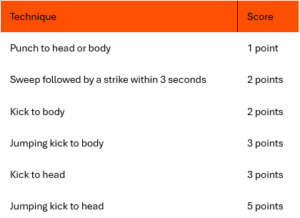
10. Scoring Procedure
WKO’s modern system uses:
1 Chief Referee + 2 Side Referees
The Chief Referee controls the bout.
When a scoring exchange occurs:
The Chief Referee stops the action.
The referees determine whether a valid technique landed.
The referees determine the value of the technique.
At least 2 of the 3 referees must agree that a score occurred.
The Chief Referee awards the points.
The competitors return to position.
The bout resumes.
Only the Chief Referee awards the points.
11. Unclear Technique Classification
Where the judges agree that a valid scoring technique landed but disagree over whether it was a punch or kick, WKO provides that the competitor still receives points.
In such circumstances, the lower applicable scoring value is awarded.
12. Bout Duration
Eliminations
WKO provides:
1 × 1 minute, or
1 × 1.5 minutes
depending upon the event/division.
National Finals
1 × 1.5 minutes
International Finals
2 × 1 minute
with 30 seconds rest between rounds.
13. Draws
If a bout finishes level:
Extra time
A further 30 seconds is contested.
If the competitors remain level:
Sudden death
The first valid scoring technique wins.
14. Ten-Point Lead
A competitor achieving a 10-point lead ends the bout by TKO under the WKO Pointfighting rules.
15. Leaving the Fighting Area
Competitors are expected to remain within the fighting area.
WKO provides:
Three warnings for leaving the area = point deduction
Fourth occurrence = disqualification
A competitor must not deliberately leave the area to avoid fighting or waste time.
16. Referee Authority
The referee may stop the bout for:
Safety reasons
Warnings
Penalties
Equipment checks
Medical concerns
Other circumstances requiring intervention
WKO states that only the referee, doctor or WKO president may stop the fight.
17. Coaching
Only one coach per fighter is permitted under the WKO Pointfighting rules.
The coach must remain seated during the bout.
The coach may signal a timeout by making a “T” with the hands.
A coach must not enter the fighting area.
Entering the fighting area may result in disqualification.
18. Clothing & Personal Items
The following are prohibited:
Jewellery
Zips
Buttons
Pockets
Glasses
Metal objects
Long hair should be securely tied back.
Soft contact lenses are permitted at the competitor’s own risk.
Protective sports goggles may be permitted where necessary, although WKO does not recommend them for competition because of the potential risk of orbital injury.
19. Sportsmanship
Gōdō Martial Arts expects every student to demonstrate:
Respect for their opponent
Respect for officials
Controlled technique
Appropriate contact
Discipline
Good sportsmanship
Immediate obedience to the referee/instructor
Pointfighting is a controlled sport. The objective is to demonstrate speed, accuracy, timing, distance and technical ability—not to cause injury.
20. Gōdō Training Levels
For club training, Gōdō Martial Arts will use three levels of sparring.
Level 1 — Technical Sparring
Purpose: Learn movement, distance and scoring.
Very light contact
Controlled techniques
No power striking
Instructor-controlled exchanges
Full PPE required
Level 2 — Points Sparring
Purpose: Develop competition-style Pointfighting.
Controlled competition-speed techniques
Clean scoring techniques
Action stopped after recognised scores
WKO scoring system
Full PPE required
Level 3 — Competition Preparation
Purpose: Prepare experienced students for WKO competition.
WKO Pointfighting rules
WKO scoring
WKO referee commands
Competition-style rounds
Competition-standard PPE
Increased intensity subject to instructor approval
The instructor has absolute discretion to reduce contact or stop sparring where safety requires it.
21. Instructor Safety Rules
The instructor may stop or modify sparring at any time.
Sparring must be stopped immediately where:
A student loses protective equipment
A mouthguard is removed
A student is injured
A student loses control of technique
Contact becomes excessive
A student deliberately ignores instructions
Unsporting behaviour occurs
Equipment becomes damaged
The instructor considers continued participation unsafe
Students must immediately obey the commands:
STOP
BREAK
TIME
22. Gōdō Student PPE Checklist
Before participating in Pointfighting, students must ensure:
Head guard fitted correctly (mandatory juniors)
Gum shield fitted
Pointfighting gloves fitted
Shin guards fitted underneath clothing
Foot protection fitted
Groin protection fitted underneath clothing
Any additional required protection fitted
No jewellery
No watches or fitness trackers
No glasses unless specifically authorised
Long hair secured
Equipment is clean and undamaged
Clothing contains no prohibited zips, buttons or exposed hard objects
23. Parent/Guardian Guidance
Parents and guardians should ensure that their child’s protective equipment is:
The correct size
Properly fitted
Clean
In good condition
Replaced when damaged or excessively worn
Students must not participate in Pointfighting without the required protective equipment.
Where equipment is missing or unsuitable, the instructor may require the student to undertake non-contact technical training instead.
24. Competition Preparation
Students wishing to compete under WKO rules should inform the instructor in advance.
Competition preparation will include:
WKO Pointfighting rules
Legal and illegal techniques
Scoring recognition
Referee commands
Competition etiquette
Equipment checks
Fighting-area awareness
Controlled contact
Tournament behaviour
The instructor will determine when a student is sufficiently experienced, technically competent and mature to participate in competition.
25. Governing Rule
This document is intended as a Gōdō Martial Arts training and competition-preparation standard based upon the WKO Pointfighting rules.
Where WKO publishes an updated rule, competition regulation or event-specific requirement, the current WKO competition rule takes precedence for WKO-sanctioned competition.
The official WKO Pointfighting rules should therefore always be checked before entering a WKO event.
Official WKO Pointfighting Rules:
https://www.worldkickboxingorganisation.org/pointfighting
Official WKO Legal & Foul Techniques document:
https://www.worldkickboxingorganisation.org/_files/ugd/0d1330_e992f24e30634ce68d21b74d47dfa1ef.pdf
Sources checked: World Kickboxing Organisation Pointfighting rules and WKO Legal/Foul Techniques document. (WKO-kickboxing) correct as at 24 August 2026